Nebuliser battery and charging: care, USB and travel tips
How to look after the battery of a portable mesh nebuliser, charge it safely over USB and pack it for a trip. Practical steps and checklists, with the manufacturer's manual as the final word.
The big advantage of a portable mesh nebuliser is that you are not tied to a wall socket. That freedom depends entirely on the battery, though. Finding the device flat when a dose is due is frustrating. This guide covers practical ways to look after the battery, charge over USB safely and avoid power problems on the road.
One important note: charging time, battery type and whether the device can be used while charging all vary by model. Your manufacturer's user manual is always the final word. What follows are general habits, not a replacement for the manual.
First, find out how your device is powered
Most portable mesh nebulisers run on a rechargeable battery. Some models use replaceable batteries instead. Check the box contents and the manual to answer these questions:
- What kind of battery does it use (built-in rechargeable or replaceable)?
- What type of charging port does it have, and which cable comes in the box?
- Can the device be used while it is charging?
- How does the charge indicator work (colour, flashing pattern)?
This information is on the product page or in the manual. If it is not, do not guess. Ask us.
Daily habits that make the battery last longer
Rechargeable batteries wear out over time. You cannot stop that completely, but you can slow it down.
- Keep it away from heat. Do not leave the device in a parked car in summer, next to a radiator or on a sunny windowsill.
- Be careful with cold, too. If it has been somewhere very cold, let it come up to room temperature before charging.
- Do not run it flat every time. A battery left empty for a long period can be damaged. Plug it in when the indicator warns you.
- If you will not use it for a while, store it with the battery around half full and check it now and then. If the manual gives different advice, follow that.
- Do not charge unattended. Avoid charging overnight or on a bed or pillow. Use a hard, flat surface.
- If the battery gets hot, swells or smells odd, stop using the device and contact us.
- Do not skip cleaning. A clean, dry device is better for the mesh plate and the electronics. For the steps, see How to clean a mesh nebuliser.
USB charging: which source, and when?
USB charging is handy because you can find a port almost anywhere: at home, at work or in the car. Still, not every USB source suits every device. The safest approach is to use the cable from the box and a charging source the manual recommends.
| Charging source | Best used | Watch out for |
|---|---|---|
| USB wall adapter | Everyday charging at home | Use the adapter type named in the manual; do not use a damaged adapter |
| Computer USB port | At a desk, when you have no adapter | Charging can be slow; use it if the manual allows |
| Power bank | On trips, where there is no socket | Use it only if the manual permits; choose a sound, good-quality unit |
| Car USB port | On long drives | Plug in while the engine is running; do not leave the device in a hot car |
Looking after the cable and the port
- Pull the plug out by the connector, not by the cable.
- Keep dust and moisture out of the charging port. If the port is wet, let it dry before charging.
- Do not use a frayed or kinked cable. Replace it.
- A spare cable in the bag means one less thing to go wrong on the road.
Power on the road: a pre-trip checklist
When travelling, the aim is to carry the device so that it works and stays safe. Before you leave, go through these steps:
- Charge the battery ahead of time. Do not leave it to departure day. Charge it the evening before.
- Clean and dry the device. Never pack it damp.
- Pack the cable and the adapter. Think about the socket type at your destination and take a plug adapter if needed.
- If you carry a power bank, remember that rules for flights can differ. Check the airline's own pages for its battery and power bank rules before you travel.
- Keep the device in your hand luggage. In the hold it can get damaged, and you cannot reach it when you need it.
- Take spare parts. Have a look at Masks and Mouthpieces for spare masks and mouthpieces, and Spare Parts for items such as plates.
- Carry medication as your doctor has told you. Having the prescription and medicine details with you can make checkpoints and journeys easier.
- Protect the device from heat on the way. Do not leave it on the dashboard, in the glovebox or in a hot boot.
Mesh and compressor devices: the difference in power
Mesh devices are small and light, so they can be built to run on a battery. Many compressor models, by contrast, work from the mains. That is why people who travel often, or take the device to school or work, tend to look at battery-powered mesh models. If you will use it in one fixed spot at home, compressor models are also an option. Check each product page to see which models run on a battery: Mesh Nebulisers and Compressor Nebulisers.
Is the battery getting worse? Look for these signs
- After a full charge, the device runs noticeably shorter than it used to.
- The charge light behaves oddly, or the device is not recognised when plugged in.
- The device keeps switching off during use.
- The body gets unusually warm.
The fault may also be the plate rather than the battery. If the mist has weakened, first read the clogging signs in When should a mesh plate be replaced?. Do not try to open the device and repair the battery or charging circuit yourself.
What to look for in a rechargeable model
- Are the charging method and the cable in the box stated on the product page?
- What does the manual say about use while charging?
- Will you use it several times a day, or only now and then?
- If you will carry it around, is it a size that fits your bag?
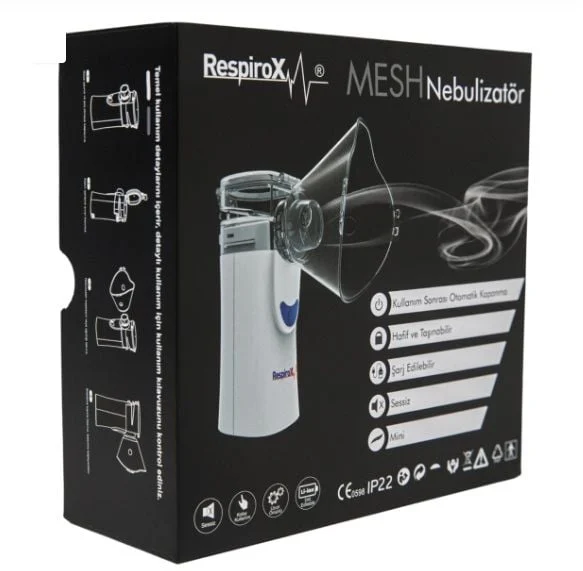
As one example, the Respirox UN100 Rechargeable Mini Mesh Nebuliser is named as rechargeable, so its page is a good place to start. You can find other portable models under Mesh Nebulisers. Battery and charging details for each product are on its own page and in its manual.
A nebuliser only turns the medicine your doctor has prescribed into an inhalable mist, so ask your doctor or pharmacist about the type, dose and frequency of any medication, and if you have questions about batteries, charging or choosing a device, you can reach us through our contact page.
Frequently asked questions
- Can I use my nebuliser while it is charging?
- It depends on the model. Some devices should not be used while charging. Check your device's user manual.
- Can I charge a nebuliser with a phone charger?
- If the manual allows it and the cable and adapter are in good condition, it is usually fine. Even so, start with the cable from the box and the charging source the manual recommends.
- Can I take a nebuliser in my hand luggage on a plane?
- Carrying the device in your hand luggage is generally the safer choice. Rules for batteries and power banks differ between airlines, so check the airline's pages before you travel.
- Should I drain the battery completely before each charge?
- No. Running the battery down to zero every time can wear it out. Unless the manual says otherwise, charging when the warning light comes on is enough.
- How should I store the battery if I will not use the device for a while?
- Keep it somewhere cool and dry with the battery around half full, and check it from time to time. Follow the manual's storage advice if it gives any.
- What if the battery runs out when a dose is due?
- The best precaution is to charge fully before you leave and to carry a cable or power bank. Ask your doctor in advance what to do if the device cannot be used.
This article is general information, not medical advice. Your doctor and the user manual determine how the device and medication are used.